You've been told to sit up straight your whole life. Here's why strength does what reminders never could.

Reformer Pilates can help your posture because it builds strength in the muscles that hold you upright: your upper back, your deep core and your glutes. Better posture usually isn't about remembering to sit up straight. It's about being strong enough that upright stops feeling like hard work.
If your day goes car, desk, car, couch, your body spends a lot of hours in one shape. Shoulders drift forward, hips stay bent, and the muscles along your back and backside don't get much to do. Then someone tells you to "stand up tall" and it lasts about four seconds.
In all honesty, one of the first things we notice as someone attends more classes is how much more "upright" they are when they sit on a machine.
Quick takeaways
Posture is mostly a strength and awareness thing, not a willpower thing.
Long days sitting tend to leave the upper back, glutes and deep core under-worked.
The reformer's springs give you resistance in both directions, so those muscles work through the whole movement.
A coached class means someone is watching your alignment, so you're not guessing.
Reformer Pilates is a workout, not a treatment. If you have pain, see a physical therapist or doctor first.
The easiest way to try it: 21 days unlimited for $99.
Can reformer Pilates actually improve your posture?
It can help, and here's the honest version of why. Posture is the position your body settles into when you're not thinking about it. If the muscles that hold you upright are strong and you know what "lined up" feels like, that's where you'll settle more often. If they're tired or switched off, you'll sink back into the slump, no matter how many reminders you set.
Reformer Pilates works on both sides of that. It builds strength, and it builds awareness, because every movement asks you to control where your spine, ribs, pelvis and shoulders are. Over time, that control starts to show up outside the studio too: at your desk, in the car, carrying a toddler on one hip.
What we won't tell you is that a class will "fix" your back or undo every hour you've ever spent sitting. Bodies don't work like that, and anyone promising it is overselling. What strength does is give you more options.
What does a day of sitting do to your body?
None of this is bad or broken. It's just what happens when a body does the same thing for hours.
TABLE 1: What sitting tends to do, and what a reformer class trains
Long-day habit | What tends to happen | What a reformer class works on |
|---|---|---|
Shoulders rounded over a keyboard or steering wheel | Chest feels tight, upper back gets little work | Upper back and shoulder strength, opening across the chest |
Hips bent for hours | Front of the hips feels short and stiff | Lengthening the front of the hips under control |
Sitting on your glutes all day | Glutes do very little | Glute strength through full range of motion |
Slumping when you're tired | Deep core switches off | Deep core and spine control |
The pattern is pretty simple. The muscles at the front get used to being short, and the ones at the back get used to doing very little. So the job is to give the back of your body some real work, and to teach the front how to lengthen again under control.
Why the reformer is good at posture work
Resistance in both directions. The springs push back as you press out and as you control the carriage home. That means your upper back and glutes are working through the whole range, including the slow return, which is where a lot of the strength comes from. If you want the full breakdown, our post on why reformer Pilates builds real strength goes deeper.
The carriage tells on you. A moving carriage is very honest. If one side is doing more work, or your shoulders are creeping up to your ears, you'll feel it wobble. That feedback is half the point. You learn what lined up feels like by noticing when you're not.
Time under tension. In a sculptme class we hold positions longer so you actually feel the muscle doing the work. For posture muscles, which are built to hold you up for hours, that kind of steady work makes a lot of sense.
Someone is watching. Classes are kept small so your instructor can coach you, and we don't overfill them. A good instructor will catch the rib flare, the dropped shoulder or the tucked pelvis before you even notice it. You can read more about how we build classes on the method page.
Is reformer Pilates better for posture than mat Pilates?
Both teach the same ideas about control and alignment. The difference is the springs. On the reformer, the resistance can go up as you get stronger, and the carriage gives you feedback a mat can't. Mat work is mostly your own bodyweight, which is great, but it's harder to load the upper back and glutes in a progressive way. Our post on reformer vs mat Pilates lays out the full comparison.
What if I have back pain?
Please talk to your doctor or physical therapist first, and tell your instructor before class. Our class policies ask everyone to let us know about injuries, pregnancy or medical concerns so we can look after you. Every movement in a sculptme class can be modified, but a group class isn't a replacement for treatment, and we'd never want you to treat it like one.
How often do you need to go to notice a difference?
Consistency matters more than intensity. Two or three classes a week is a realistic place to start for most people, and it's enough to build strength you can feel in everyday life. We get into this properly in how often should you do reformer Pilates?.
A few things that make it stick when your days are full:
Book ahead. The sculptme app lets you book up to 14 days out, so your classes are in the calendar before the week fills up.
Go early if mornings are yours. Classes start as early as 5:30am, which means you can be done before the first meeting.
Pick the same times each week. A habit you don't have to decide on every week is a habit you'll keep.
Start building the strength that holds you up
The easiest way to find out what your posture feels like with a stronger back is to try it. The 21 Day Intro Offer is 21 days of unlimited classes for $99. You get every class on the schedule, grip socks on us and weekly check-ins, and your 21 days don't start until your first class. No experience needed.
If you love it, every membership is month-to-month, with no lock-in. If you're nervous about your first class, here's what to expect.
You've spent years being told to sit up straight. Let's build the strength that does it for you. You can do this, and we're here for you. Start your 21 days for $99 at our Fort Worth studio.
About the Author
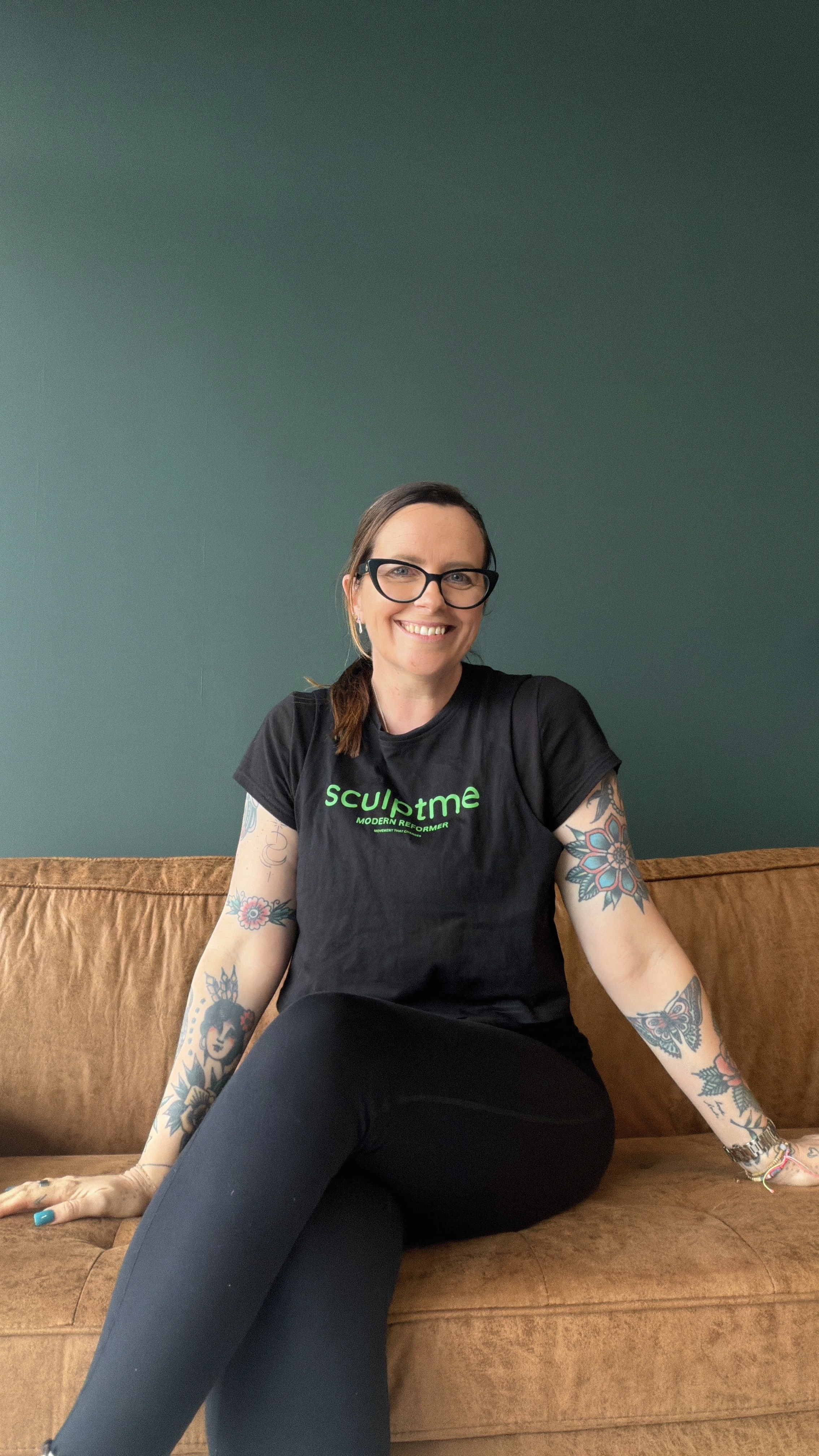
Nicole has 15 years teaching reformer Pilates across two continents — Australia to the U.S. — and still believes the best is ahead of you. She built sculptme to be the room where you get stronger and actually feel supported doing it.